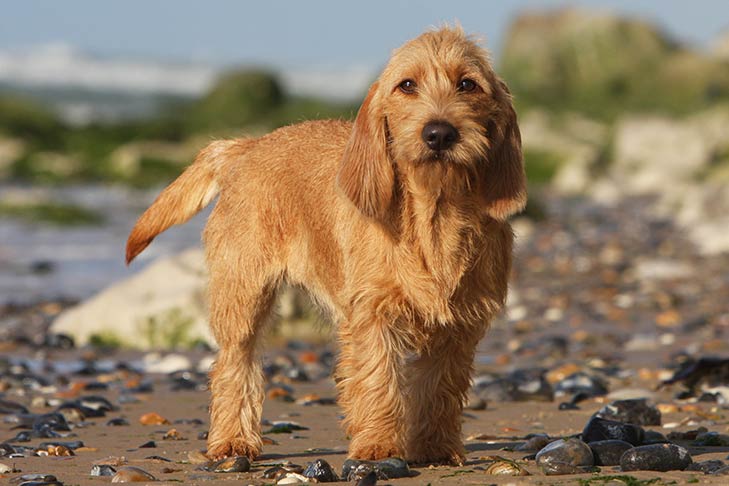
Along with its short legs, sweet expression, and cheerful disposition, the Basset Fauve de Bretagne is a bold, rugged, and old hunting hound with ties to French royalty. Happy to sound its characteristic hound voice of “aahrooo,” before chasing rabbits across a field, this small, stocky breed is as eager to learn new sports as it is to spend time with its family on home movie nights.
The Basset Fauve de Bretagne’s Beginning


The earliest Basset Fauve de Bretagne appears in art during the 1300s. Also known as the Fawn Colored Brittany Basset, the Bassett Fauve de Bretagne dates to the 15th century, with its larger relatives, a pack of Breton hounds consisting of the Grand Fauve de Bretagne, or Fawn Hound of Brittany.
During the Middle Ages, from the fifth to the 15th centuries, only nobles, barons, and kings could keep hounds and hunt with them while on horseback. The aristocracy pursued wolves and wild boar in Brittany, a peninsula in northwestern France known for dense hedges, bushes, and rough terrain with an abundance of wild game.
Around 1520, Breton Admiral Claude d’Annebault introduced the 27.5 to 29.5 inch Grand Fauve de Bretagne to the French court. In 1570, the Grand Fauve de Bretagne was the principal breed of French hounds. A stud dog named “Mirraud” was used extensively in the king’s pack. The Grand Fauve de Bretagne accompanied King Francois I of France on his hunting expeditions to the region for pleasure and to oversee business in the area.
“Pack owners cared less about the dog’s appearance and valued a dog’s hunting ability,” says Cindy Hartman, President of the Basset Fauve de Bretagne Club of America. “The Monks were the first to maintain written records of breeding hounds used in hunting from 750 to 900.”
From Long to Short-Legged Hounds
At the beginning of the French Revolution in 1789, the hunting rules changed, and anyone could own a hound and use it to pursue game. Because peasants could not afford to purchase a horse, they could only hunt on foot and needed a smaller, short-legged, closer-ranging hunting companion.
Around the same time, the Grands and the Griffons Fauve de Bretagne had become popular but peaked in the 1800s, and their numbers decreased when the wolves disappeared. The Grand Basset de Bretagne became extinct in the 1800s as the need for a big dog decreased.

The smaller, rough-coated Griffons and the Basset Fauve de Bretagne, measuring between 12.5 and 15.5 inches tall, retained the genetic heritage of their larger ancestor and were more in demand.
“Hunters needed a smaller dog, so they bred down the smallest dogs to the smallest dogs and developed the Basset Fauves de Bretagne,” Hartman says. “Basset means low-set bred down from larger, taller, to shorter, smaller.”
With the Grand’s features identical to the Basset’s, the hunters trained their dogs to pursue smaller game. By the 19th century, hound packs of four Bassets ran together to hunt rabbits, hare, fox, roe deer, and wild boar. They adapt to all types of terrain and are lively, energetic, and fast for their size.
During World War I from 194 to 1918, the numbers of many breeds decreased with the risk of becoming extinct. “To increase the number of Fauves and to maintain their hunting instinct, breeders bred them to Wirehaired Dachshunds,” Hartman says.
One of Four Recognized Basset Breeds
The Basset Fauve de Bretagne is one of four Basset breeds. The other breeds include the Basset Hound, the Grand Basset Griffon Vendeen, and the Petit Basset Griffon Vendeen. Although their conformation and coat types differ, the Fauves have the shortest backs. Two other Bassets, the Basset Artesien Normand and the Basset Bleu de Gascogne, are also French breeds.
Hunting Ability A Priority
“In May 1923, Sir John Buchanan Jardin showed a pack of Basset Fauves at a dog show in Paris, France, titled ‘Exposition Canine de Paris Sui Yang,’ ” Hartman says. “The French club formed with the motto, ‘Chasse de Bourd (hunt first)’ and they feel strongly that Fauves should possess the ability to hunt as a priority.”
If the dog does not have an opportunity to hunt, it should possess a strong work ethic and the intelligence to excel at performance sports and act responsibly inside the house. “They should be awesome to live with and be able to work all day and curl up with you on the sofa at night,” Hartman says.
The ability to track, sniff out game, search, and locate is necessary for hunting, and these skills are the same as those required in performance sports.
Recognition in the U.S.
Cindy Hartman of Central, South Carolina, was the first person in the U.S. to have a Basset Fauve de Bretagne 25 years ago. “I did some research about different French breeds, went to France, and visited kennels,” Hartman recalls. Drawn to Fauves, she went to observe a hunt and was impressed when the owner called the Fauves on pursuit to return, and they complied.
Hartman returned home with a male puppy, “Sprig,” and a female puppy, “Sprite,” from different litters. “I liked their versatility as they circle back and stay with you while out hunting.”
Hartman liked that her new puppies interacted well with her other pets. “I had German Wirehaired Pointers and pet rabbits, but they knew the difference between a pet and wild rabbits.”
Many Fauves followed in the Hartman household, and she participates in AKC Fast CAT with her male. When Hartman’s dog received an invitation to compete at AKC’s 2024 FastCAT Invitational, Hartman was optimistic he would go home with a top score. He qualified the first two days before it rained that night. “There was a little mud puddle on the course, so the dog stopped, took a small drink of water, but didn’t remember which way to go, so he returned to the start,” Hartman recalls. “He was such a happy boy, and everyone laughed.”
The Basset Fauve de Bretagne Club of America was formed in 2013. Assigned to the Hound Group, the Basset Fauve de Bretagne has been recorded in the Foundation Stock Service since February 2015. The breed is a member of the Miscellaneous Class and is eligible to compete in the Hound Group effective January 1, 2026.
Three new dog breeds have received AKC breed recognition in 2026! Meet the Russian Tsvetnaya Bolonka, the Basset Fauve de Bretagne, and the Teddy Roosevelt Terrier.